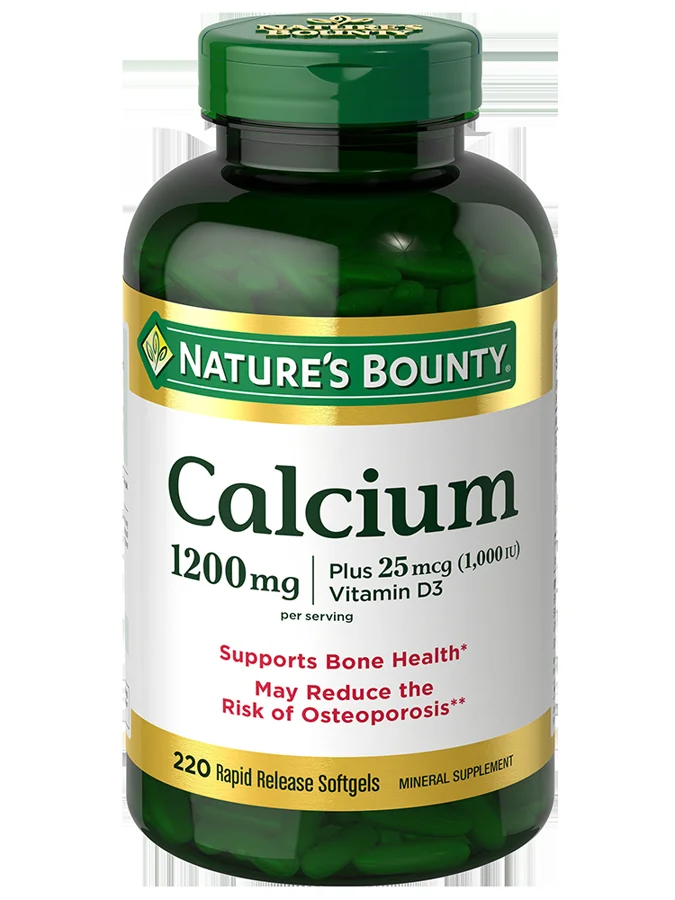
What's actually on the label
This review covers the flagship Nature's Bounty "Absorbable Calcium" softgel line (220-count bottle, also sold in 120- and 200-count sizes) — a different product, and a different calcium source, from the calcium citrate formats a sister site of ours has covered separately. We pulled these figures directly from the Supplement Facts panel published on Nature's Bounty's own site and cross-checked them against the same listing on three additional retailers.
| Calcium per serving | 1,200 mg (92% Daily Value), as calcium carbonate |
|---|---|
| Vitamin D3 per serving | 25 mcg / 1,000 IU (125% Daily Value) |
| Serving size | 2 softgels daily, label directs "preferably with a meal" |
| Bottle count | 220 softgels (110 servings); also sold in 120- and 200-count sizes |
| Other ingredients | Soybean oil, gelatin, vegetable glycerin; <2% corn oil, mannitol, sorbitan solution, soy lecithin, titanium dioxide color, yellow beeswax. Contains soy. |
| Label claims | No artificial flavor, no sugar, no starch, no milk/lactose, gluten free, no wheat, no yeast, no fish, sodium free |
| Manufacturing | Made in a GMP facility, per the manufacturer; finished-product testing is done in-house, not by an outside lab |
| Third-party verification | Not enrolled in the USP Dietary Supplement Verification Program — we checked USP's own verified-product list and didn't find this line on it |
| Made by | Nestlé Health Science (The Bountiful Company). A sale of this business, Nature's Bounty included, to Yellow Wood Partners was announced in September 2026 and is expected to close in 2027 — ownership may change during that window |
| Recalls / legal actions | None found specific to this calcium + D3 line as of September 2026 |
One label detail worth flagging plainly: this is calcium carbonate, not calcium citrate. Carbonate needs stomach acid to dissolve properly, which is why the label calls for taking it with a meal. It's a cheaper, more concentrated form per tablet than citrate, and it works fine for most people who take it as directed — but it's a real practical difference from citrate-based products, not a marketing detail.
What the research actually shows
Calcium and vitamin D3 for bone health is one of the most heavily studied areas in the entire supplement aisle, and the honest picture is more nuanced than "take this and your bones get stronger."
1,200 mg of calcium is close to the dose used in the classic Chapuy et al. trial (New England Journal of Medicine, 1992), which paired 1,200 mg calcium with 800 IU vitamin D3 and found a real reduction in hip fractures. But that trial studied frail, institutionalized nursing-home women in their 80s — not the community-dwelling adult most likely to be reading this review. That distinction matters for what you should expect from the bottle.
The most current, most relevant guidance for a typical reader of this site comes from the U.S. Preventive Services Task Force's 2024 recommendation: with moderate certainty, it found that vitamin D supplementation, with or without calcium, has no net benefit for the primary prevention of fractures or falls in community-dwelling postmenopausal women and men age 60 and older. A separate Cochrane analysis of institutionalized elderly adults did find a modest hip-fracture reduction with combined calcium and D — so the benefit that first put this combination on the map is real, but it's strongest in a frailer, more supervised population than most people buying this bottle on Amazon.
There's also a genuinely unresolved safety question. A widely cited pooled analysis (Bolland et al., BMJ, 2010) found calcium supplementation associated with a higher relative risk of heart attack across a set of randomized trials; later meta-analyses on this question have been mixed, with some finding an association and others not. The large Women's Health Initiative trial, which studied combined calcium plus vitamin D specifically (rather than calcium alone), did not reproduce the same cardiovascular signal. We're not asserting this product carries a cardiovascular risk — the evidence genuinely doesn't settle that either way — but a source that only told you the encouraging half of this research wouldn't be giving you the real picture.
One more practical point that rarely makes it onto a product page: because this is calcium carbonate, absorption depends on stomach acid. Adults taking a proton pump inhibitor or other long-term acid-reducing medication — common in this site's readership — may absorb it less efficiently, and a calcium citrate product (which doesn't require stomach acid to dissolve) is generally the better-suited alternative for that specific situation.
Who this is a reasonable fit for
Worth considering if
Your usual diet runs short on calcium, you don't take long-term acid-reducing medication, and you're consistent about taking it with a meal as directed.
Worth considering if
You've had trouble swallowing large calcium tablets — the softgel format is generally easier to take than the chalky tablets some competitors use.
Consider a citrate form instead if
You take a proton pump inhibitor, H2 blocker, or other long-term acid-reducing medication that limits carbonate absorption.
Talk to your doctor first if
You have a history of kidney stones, hypercalcemia, or cardiovascular disease — given the unresolved research above, that's a conversation worth having before adding any calcium supplement, not just this one.
Nothing here is a substitute for weight-bearing exercise, adequate dietary protein, or reducing fall hazards at home — all of which have at least as much evidence behind them for bone strength in older adults as any supplement does.
How we scored it
Label accuracy: matches. The dose we found on the bottle matches the Supplement Facts panel published by the manufacturer, with no discrepancy across the retailers we checked.
Certification: a real gap, not a disqualifying one. The product is made in a GMP facility per the manufacturer, but it is not enrolled in the USP Dietary Supplement Verification Program the way some competing products are.
Evidence strength: the dose closely tracks the trial that first demonstrated a fracture benefit for this combination, but that trial studied institutionalized elderly adults, and the most current (2024) USPSTF review found no net fracture/fall-prevention benefit for the community-dwelling adults who make up most of this product's actual buyers. That gap between the population the dose was proven in and the population buying the bottle is the main reason this doesn't reach our top tier.
Safety transparency: the ongoing calcium-and-cardiovascular-risk research debate is real and unsettled; we're disclosing it rather than treating it as fully resolved in either direction.
This page contains an affiliate link; if you buy through it we may earn a commission at no extra cost to you, and that relationship is decided after the score above, not before it. Full detail is in our Affiliate Disclosure.
This rating and the research summarized above are editorial judgments about publicly available evidence. Nothing on this page is intended to diagnose, treat, cure, or prevent any disease, and it isn't a substitute for advice from your own doctor or pharmacist — especially before starting a new supplement alongside existing medications.
Sources used for this review:
National Institutes of Health, Office of Dietary Supplements — Calcium: Fact Sheet for Health Professionals.
U.S. Preventive Services Task Force — Vitamin D, Calcium, or Combined Supplementation for the Primary Prevention of Fractures in Community-Dwelling Adults, 2024 Recommendation Statement.
Chapuy MC, et al. — "Vitamin D3 and Calcium to Prevent Hip Fractures in Elderly Women," New England Journal of Medicine, 1992.
Bolland MJ, et al. — "Effect of Calcium Supplements on Risk of Myocardial Infarction and Cardiovascular Events," BMJ, 2010.
Nature's Bounty (naturesbounty.com) — product listing and Supplement Facts panel, Absorbable Calcium 1200 mg + Vitamin D3 1000 IU.
U.S. Pharmacopeia (USP) — Dietary Supplement Verification Program, verified product directory.