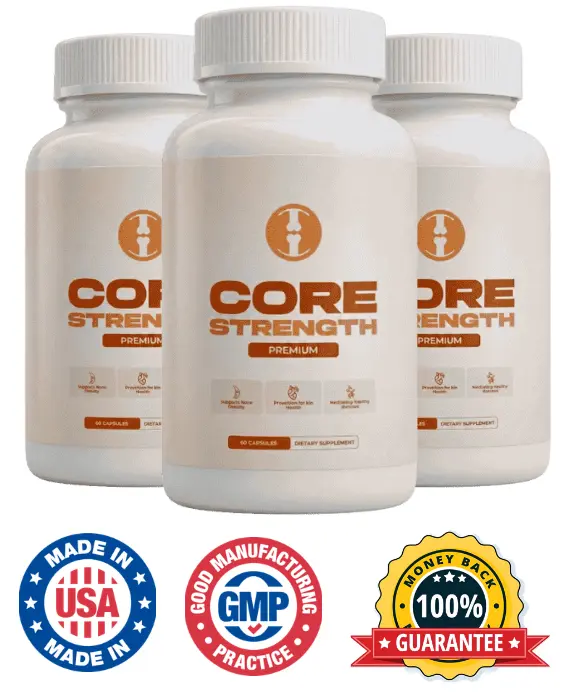
This file covers the Core Strength joint capsule sold under that name across a cluster of similarly branded storefronts. We read the ingredient panel, checked the two named ingredients against published research, and looked into a marketing pattern tied to this product that independent researchers have already documented — before publishing a score.
The label names exactly two ingredients — Japanese mountain honey and Indian golden root — and prints a total capsule weight, but no milligram amount for either ingredient on its own.
Independent researchers who looked into this product were unable to confirm a named founder, a bottling facility, or a verifiable business address behind it.
We found no published human trial testing this specific two-ingredient combination, at any dose, for joint comfort or mobility.
Video ads promoting this product have been documented using a fabricated news-style segment, an invented "toxin" explanation, and the unauthorized name and likeness of a well-known physician.
A 60-day money-back guarantee is printed on every checkout page we reviewed, including for opened or empty bottles.
Neither named ingredient is a stimulant, and the printed label copy — as opposed to the video ads built around the product — doesn't promise fast or dramatic results.
Under our verification system, a product lands below 5.0 when the evidence behind it is effectively absent, or when a labeling, sourcing, or disclosure problem is serious enough to lower confidence no matter how the ingredient list reads on its own. Core Strength hits both conditions at once: the formula itself has no dedicated clinical trial behind it, and the product's own promotional ecosystem includes marketing that independent researchers have already flagged as fabricated. Neither of those two ingredients is dangerous on its face, and the label doesn't make the wild claims the video ads do — but a rating on this site reflects the full picture around a product, not just the two words printed on the bottle.
What would move this score up: a manufacturer willing to publish exact milligram doses, a verifiable company address, and daylight put between the legitimate product and the deepfake-style ad campaigns circulating under its name.
Every listing we checked for this product — across several nearly identical storefronts using the same product name and label art — names the same two ingredients and nothing else. That's unusually short for a joint-support formula, which typically runs to six or eight ingredients. Short isn't automatically bad; it just means each ingredient is doing more work, and it makes the missing dose information more consequential than it would be in a longer, more diluted blend.
Honey shows up in the research literature mainly for wound care, cough relief, and general markers of inflammation and blood sugar response — not specifically for joint mobility in older adults. We didn't find a published human trial of an oral honey supplement aimed at joint stiffness. Separately, honey sourced from certain mountain and forest regions can occasionally carry naturally occurring plant compounds from the nectar plants bees fed on — a well-documented phenomenon in food-safety literature, sometimes called "mad honey," associated with specific rhododendron-heavy regions that include parts of Japan. We're not saying this product's honey is affected; we're saying the manufacturer publishes no sourcing or lab-testing documentation that would let a reader confirm either way, and a marketing claim built around a specific region is exactly the kind of claim that transparency should be easy to back up.
"Golden root" is a common-name label sometimes applied to the herb Rhodiola rosea in supplement marketing, but the manufacturer here doesn't specify a botanical species, plant part, or extract ratio, so we can't confirm that's what's actually in the capsule. If it is Rhodiola, the bulk of the human research on that herb looks at fatigue, stress-related tiredness, and exercise recovery — usually in younger or physically active adults — rather than joint comfort specifically in older adults. That's a mismatch worth knowing about: the herb has a real research base, just not one that lines up cleanly with how this product is being sold.
For comparison, the joint-supplement ingredients with the most human clinical research behind them are glucosamine, chondroitin, curcumin (from turmeric), and collagen peptides — none of which appear in this formula. That doesn't make Core Strength wrong to try; it means a reader choosing it is choosing a less-studied pair of ingredients over more thoroughly researched alternatives, which is a legitimate trade-off as long as it's made knowingly.
Independent researchers and fact-checking outlets have documented video ads for a "Core Strength" joint product that are built like a fake news segment — network-style graphics, an authoritative narrator, and the unauthorized name and image of CNN medical correspondent Dr. Sanjay Gupta, along with other public figures who have no connection to this product. Some versions of that ad script also invoke a supposed toxin (named as "cavium chloride") as the hidden cause of joint pain and stiffness; no compound by that name appears in real toxicology or medical literature, and it isn't a recognized cause of anything. Treat that specific claim as a fabrication built for the ad, not as medical information.
What this doesn't tell us: whether the company that actually fulfills and ships Core Strength orders authorized those ads, wrote them, or is even aware of them — it's common in this corner of the affiliate-marketing world for a product name to get reused across ad campaigns run by unrelated promoters. What it does tell us: a shopper who arrived here because of one of those videos should treat the video's claims as separate from, and less reliable than, the plain label sitting on the bottle — and should weigh that pattern into the buying decision regardless of who's ultimately responsible for it.
Every version of this product we checked lists the same basic serving structure: two capsules per day, sixty capsules per bottle, a 30-day supply. It's meant to be taken daily and continuously rather than as needed, and none of the checkout pages we reviewed suggested it works quickly — the "trial two bottles" and "buy six" bundles are structured around a two- to six-month commitment, which is consistent with how a slow-acting daily supplement is normally sold. A 60-day money-back guarantee appears on every checkout page we looked at, with wording allowing a return even on empty bottles. We have not tested how that guarantee holds up in practice; some consumer-complaint write-ups about similarly marketed products describe friction getting refunds actually processed, so keep any order confirmation and follow the manufacturer's stated return steps exactly if you go that route.
Pricing for this product is genuinely inconsistent from one storefront to the next, likely because it's sold through several near-identical funnel sites rather than a single official retailer. Here's what we captured directly:
| Storefront | Package | Price |
|---|---|---|
| corestrengthmarket.com | 2 bottles (60-day supply) | $79/bottle — $158 total + $19.99 shipping |
Other storefronts using the same product name and label art advertised tiered bundle pricing in roughly the $49–$69-per-bottle range depending on whether one, three, or six bottles were ordered at once — cheaper per bottle at higher quantities, which is a standard structure for this category, but a meaningfully different total than the figure above. We're not able to confirm which price a given reader will actually see, since these campaigns appear to rotate. Whatever the shown price, add shipping before comparing it to another product, since several of the checkout pages we reviewed listed shipping separately rather than folding it into the headline price.
This is a reasonable candidate for someone who wants a simple, low-stimulant supplement to try alongside — not instead of — approaches with a stronger evidence base, who understands the ingredient panel is short and its doses undisclosed, and who buys directly rather than clicking through the deepfake-style video ads built around the product name. It's a poor fit for someone who saw one of those videos and is expecting the dramatic, fast relief the ad implies, or for someone who wants a joint supplement backed by a published trial on the actual formula they're taking — that trial doesn't currently exist for this product.
Pricing on the manufacturer's own funnel sites shifts by campaign, so the number above may not match what you see at checkout. This is an affiliate link — full detail on how that works is on our Affiliate Disclosure page.
Check Current Price →Core Strength earns an Under Review score of 4.1/10 — not because honey or an adaptogenic root are unsafe ingredients, but because the label withholds the dosing information that would let anyone judge whether the amounts used match any relevant research, the company behind it isn't independently verifiable, and the product's name is attached to a documented pattern of fabricated, deepfake-style advertising that has nothing to do with the actual capsule. A reader who still wants to try it should do so with those specific gaps in mind, order directly rather than through a dramatic video pitch, and treat any claim of fast or guaranteed results — wherever it appears — as marketing, not as something printed on the label.
Sources & verification notes:
Manufacturer checkout page reviewed directly for formula, serving size, and pricing: corestrengthmarket.com (captured 2026-09-15).
Documentation of the fabricated news-style ad campaign, invented toxin claim, and unauthorized use of a physician's name and likeness: independent consumer-fraud research published by Jordan Liles and by MalwareTips.com.
General reference on honey-borne plant compounds ("mad honey") and regional prevalence: peer-reviewed toxicology literature indexed via the National Library of Medicine (PMC).
General reference on Rhodiola rosea research scope: peer-reviewed herbal-medicine literature indexed via the National Library of Medicine (PMC).
This rating is an editorial judgment about publicly available evidence and marketing claims. It is not a certification from a government body, laboratory, or the product's manufacturer, and it is not medical advice. Nothing on this page is intended to diagnose, treat, cure, or prevent any disease. Talk to a healthcare provider before starting any new supplement or changing an existing routine.